


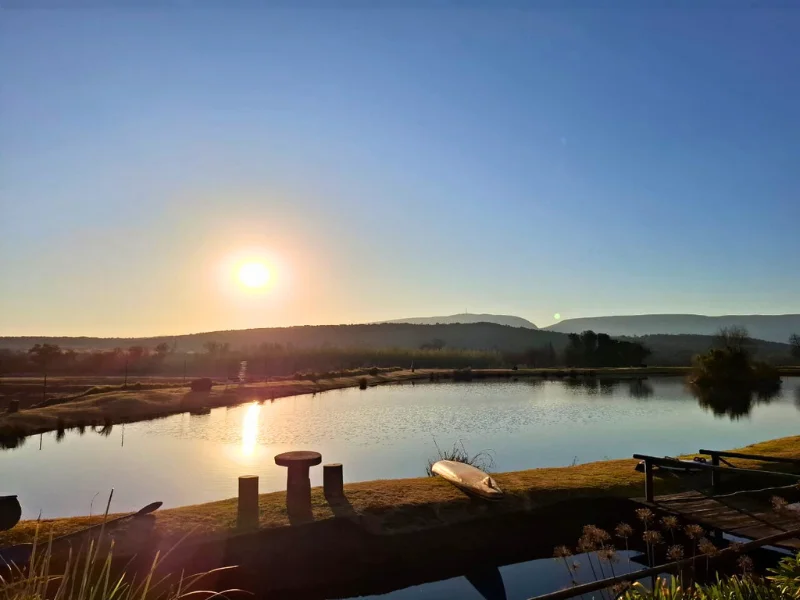
Most Johannesburg residents have never seen the Milky Way. Not the faint smear of it that’s occasionally visible on a clear night from a dark suburb, but the full arc — visible without a telescope, dense with stars, stretching from horizon to horizon. This isn’t because the Milky Way isn’t there. It’s because Joburg’s light pollution drowns it.
An hour from the M1, in the Hekpoort Valley, the situation is completely different. The valley has minimal artificial lighting, the mountain range to the north blocks the Rustenburg light dome, and the Highveld altitude gives the air a clarity that’s absent at sea level. On a clear winter night, the Milky Way is unmistakable.
Why Is the Magaliesberg Good for Stargazing?
Three factors combine to make the Magaliesberg and Hekpoort Valley one of the better stargazing locations within easy reach of a South African major city:
Low Light Pollution
The Hekpoort Valley is surrounded by farmland and mountainous terrain rather than urban development. The nearest significant light source — Krugersdorp — is 30km away and partially blocked by terrain. Harties and the R511 corridor add some ambient light to the east, but the western and northern sky over the valley is genuinely dark by Gauteng standards.
Altitude and Atmospheric Quality
Johannesburg sits at approximately 1,700 metres above sea level, and the Magaliesberg area is at similar altitude. The reduced atmosphere at this elevation gives the stars a clarity and brightness that lower-altitude locations don’t produce. The dry Highveld air in winter — no humidity, no haze — amplifies this further.
Climate and Clear Nights
According to the South African Weather Service, the Gauteng region averages around 300 clear days per year, with the majority falling in the May-August dry season. This is exceptional for a South African city-adjacent location. The combination of dry winters and the region’s position on the Highveld plateau produces consistent clear-sky conditions that coastal cities simply don’t have.
What Can You See in the Magaliesberg Night Sky?
The Milky Way
The Milky Way band is visible from the Hekpoort Valley on clear moonless nights throughout the year, but is best seen from approximately April through September when the galactic core rises in the south and east. In midwinter (June-July), the core is well-positioned in the evening sky and visible from dark locations in the valley for most of the night.
The Southern Hemisphere Stars
South Africa has a distinct advantage over the Northern Hemisphere in stargazing: the Southern Cross, the Magellanic Clouds, and the dense star fields of the galactic centre are all visible. The Magellanic Clouds — two companion galaxies to the Milky Way, visible to the naked eye — are a consistent source of wonder for visitors from the Northern Hemisphere who’ve never seen them.
Planets
The planets visible to the naked eye — Venus, Mars, Jupiter, Saturn — follow predictable cycles. Using a free app like Stellarium before your visit lets you know what’s currently well-placed in the evening sky.
Meteor Showers
Several major meteor showers are visible annually from South Africa. The Geminid meteor shower (mid-December) and the Perseid shower (mid-August) consistently produce reliable displays from dark-sky locations. The Magaliesberg valley’s low light pollution makes these showers significantly more impressive than they appear from the city.
When Is the Best Time for Stargazing Near Johannesburg?
Best season
May through August is the optimal stargazing season near Johannesburg. The dry Highveld winter produces clear, stable nights with no cloud and no humidity. Temperatures drop to 2-8°C in the Hekpoort Valley on winter nights — bring a warm jacket and a blanket.
Moon phase
The moon dramatically affects stargazing quality. A full moon washes out all but the brightest stars. New moon and the days immediately before and after it produce the darkest skies. Plan your stargazing trip around the lunar calendar — a dark moon combined with a clear winter night in the Hekpoort Valley is genuinely exceptional.
Time of night
The sky improves as the evening progresses, reaching best conditions between midnight and 3am for most of the year. For casual stargazers staying at a property overnight, a dedicated session from 9pm to 11pm produces excellent viewing on a moonless winter night.
What Equipment Do You Need for Stargazing in the Magaliesberg?
For a rewarding stargazing experience at a Magaliesberg property, you need surprisingly little:
- A dark location: the property’s grounds, away from indoor lighting. Most Hekpoort Valley properties have natural dark areas on the farm
- A blanket or reclining chair: stargazing requires looking up. Lying flat on grass or reclining in a chair is dramatically more comfortable than standing and craning your neck
- Warm layers: Highveld winter nights are cold. Dress warmer than you think you need to
- A red light torch: white light destroys night vision in about 30 seconds. A red-light torch (or a phone with a red filter app) preserves the adaptation that makes stargazing work
- A stargazing app: Stellarium (free) or SkySafari are the most useful. These apps overlay the sky with constellation labels, planet positions, and satellite passes in real time
For a significantly enhanced experience, a small binocular (10×50) reveals star clusters, the detail of the Milky Way, and the Magellanic Clouds in much more resolution than the naked eye. A telescope is not necessary for a rewarding first stargazing experience.
Can You Stay Overnight at a Magaliesberg Property for Stargazing?
Yes — and an overnight stay is the recommended approach. Arriving at a property in the afternoon, spending the evening around a fire, and then stepping outside for 45-60 minutes of stargazing as the fire dies down is the format that most guests describe as memorable.
At Imbabali Retreat and Venue in the Hekpoort Valley, guests staying overnight in the self-catering cottages or other accommodation units regularly describe the night sky as one of the highlights of their stay. The property’s low ambient lighting and wide outdoor grounds provide ideal conditions. Check current specials or book a stay.
Frequently Asked Questions
Can you see the Milky Way from the Magaliesberg?
Yes, consistently on clear moonless nights from late April through August. The galactic core is visible from approximately 8pm-9pm in the south and east sky during the Highveld winter season. Even from casual observation without equipment, the Milky Way band is unmistakable.
What is the best month for stargazing near Johannesburg?
June and July, combined with a new moon period, produce the best stargazing conditions near Johannesburg. The winter dry season consistently delivers clear nights, the galactic core is well-positioned, and the stable air produces sharp star images.
Do you need a telescope to stargaze in the Magaliesberg?
No. The Milky Way, Magellanic Clouds, bright planets, major constellations, and meteor showers are all visible to the naked eye from a dark-sky location in the Hekpoort Valley. Binoculars significantly enhance the experience; a telescope is not required for a rewarding stargazing session.
The Milky Way hasn’t changed. Johannesburg’s light pollution has. The Hekpoort Valley is the version of the night sky that was available to everyone before cities got in the way — and it’s 75 minutes from Sandton.